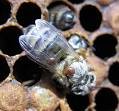
Hello from Victoria/Queensland, Australia

Welcome to NZ Beekeepers+
Would you like to join the rest of our members? Feel free to sign up today.
Sign up
4
1
Melbourne, Australia
Experience
Hobbyist
Hi all — Gergo here, keeping bees in Victoria and Queensland. AU is where NZ was ~20 years ago on varroa, so I read this forum a fair bit for the playbook — what actually worked as management matured, not just the theory. Also building on-hive monitoring tech on the side (2bee.farm) alongside the beekeeping. Appreciate any AU-relevant lessons from people who've lived through the whole arc.
 

Alastair

Founder Member
Platinum
8,908
10,078
Auckland
Experience
Semi Commercial
Your situation is worse than ours was because when mites arrived over here they were not immune to the treatments, It was just a simple case of put the treatments in, and a few weeks later the mites were gone. So we had time for a bit of a learning curve before our mites developed immunities.

Australia has got mites that are already immune. No time for a learning curve, and from what I am seeing most Aussie beekeepers still unable to see the signs of mites in their hives, then all of a sudden, their hives are dead, it is a surprise to them.

The traditional mite treatments being recommended by the Aussie government just don't work very well any more, if at all. My suggestion is go with the organic acids, being oxalic acid and formic acid. Me, all I am using now is formic acid.
 
4
1
Melbourne, Australia
Experience
Hobbyist
Really appreciate this, Alastair — that's exactly the kind of on-the-ground read I was hoping to get here. The resistance-from-day-one point is the bit that doesn't land with a lot of hobbyists here yet — most of the messaging is still "treat like everyone else does" rather than "assume the synthetic pyrethroids/amitraz are already compromised in your area, confirm with a mite wash before you trust a treatment worked."
Question on your formic-only approach if you don't mind: are you running strips (MAQS-style) on a fixed calendar, or more reactive to wash counts? And do you find formic's temperature window workable across a full season, or do you fall back to oxalic (dribble/vaporised) for the cooler brood-break window? Trying to get a realistic AU-climate treatment calendar together rather than just importing a US/UK one wholesale — sounds like NZ's already been through that translation exercise once.
 

Alastair

Founder Member
Platinum
8,908
10,078
Auckland
Experience
Semi Commercial
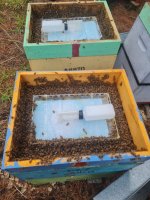
I'm using Nassenheider formic acid dispenser units as per the photo. I can't give a 100% answer exactly how to use them because I am still on a learning curve myself, and have made many mistakes, but slowly working things out. What is working best so far is two ten day treatments back to back, in hot weather in Autumn using 250 mls of 65% formic acid per treatment, and in cold spring weather using 250 mls per treatment 84% formic acid.
It is very difficult getting it right, overdo it and you kill bees, under do it and you don't kill the mites. But right now for me anyhow, not much else works reliably. Using the Formic Pro pads achieves the same thing, but way more expensive.

Nassenheider 1.jpeg
 
8,968
5,395
maungaturoto
Experience
Commercial
as alastair mentioned varroa was easy in the early days, but reinvasion was the big problem.
some of the beeks here used to treat constantly during the first few years.
but the big problem came a bit latter with beeks underdosing and most used the same strips. which resulted in the first big resistant mite scare here.

having reinvasion at the same time as resistant mites is a major problem. most alterative treatments do not handle reinvasion. so its probably a case of running dual treatments. synthetic to deal to the bulk of the reinvasion then organic to deal with resistant mites.

also heat plays a factor in treatments, plus the length of a season. every aera will have to work out what works when.

nz is still very much in the learning curve. nz's bee industry implosion and subsequent loss off half its hives and beeks, has brought reinvasion back.
 
  • Agree
Reactions: Alastair

Alastair

Founder Member
Platinum
8,908
10,078
Auckland
Experience
Semi Commercial
Good points raised by Tristan. The treatment time frame for formic acid is very short, compared to the longer time frame of synthetic strips, which covered a lot of the time period available for reinvasion.
I suspect I am getting more reinvasion than I used to when using synthetic strips although it can be hard to definitively know. However I am sometimes doing a third treatment a month or so later to cover this, and much as I do not much like them, am considering using oxalic strips after treatment to (I hope) deal with new mite arrivals.
 
4
1
Melbourne, Australia
Experience
Hobbyist
That's something I've been hearing from a few AU beekeepers too — queen supersedure rates seem to be up noticeably since varroa arrived. Hard to tell how much is the mites themselves vs the treatment regime vs genetics narrowing, but the observation is consistent.

Do you find the replacement queens are holding up any better, or is it the same pattern repeating? I've been wondering if the queens being raised now are from colonies that have already been through multiple treatment cycles, and whether that's selecting for something different than pre-varroa genetics.
 

Alastair

Founder Member
Platinum
8,908
10,078
Auckland
Experience
Semi Commercial
Here is what I have found. Going back to pre varroa times, pretty much every queen would do well for the first two years, and quite often the bees would supersede her at the end of year two. But if they did not, the third year she would not lay very well. Supersedure almost always happened in autumn. Hives almost never lost a queen in winter because if the queen was likely to fail, the bees would know that and supersede her.
Now, post varroa, both bees and queens have virus levels thousands of times higher than before we had varroa. So we see queens fail quickly, and the bees do not always know she will fail, so queens can disappear mid winter when it is not possible for the bees to make a new one and she can mate. So every year many hives are lost in winter due to queenlessness, this was virtually unknown pre varroa.
Post varroa but a few years ago I would see queens being superseded every few months. Not many would make it to the end of the two years. But now, nearly all my queens are good for two years. I do not know why this is. Could be the result of some kind of natural selection process that has been in play, but I don't know. Also, in my hives anyway, there are a lot less winter losses due to queenlessness than there used to be.

 
8,968
5,395
maungaturoto
Experience
Commercial
That's something I've been hearing from a few AU beekeepers too — queen supersedure rates seem to be up noticeably since varroa arrived. Hard to tell how much is the mites themselves vs the treatment regime vs genetics narrowing, but the observation is consistent.
it would be interesting to see what treatment they are using.

i highly doubt its directly caused by mites this early on and certainly not genetics. it could be whatever virus came with mites when they came in. or possibly amplifying the effect of an existing pathogen.
 
  • Agree
Reactions: Alastair


Top