

Yellow-legged hornet queen found nesting in Auckland
- Thread starter Jihema
- Start date
You are using an out of date browser. It may not display this or other websites correctly.
You should upgrade or use an alternative browser.
You should upgrade or use an alternative browser.
Welcome to NZ Beekeepers+
Would you like to join the rest of our members? Feel free to sign up today.
Sign up


Two more predator queen hornets found in Auckland
Experts say the species preys on honeybees and could severely impact the honey industry if a population takes hold.
 www.rnz.co.nz


Public urged to look out for hornets in Auckland | NZ Government
Biosecurity New Zealand is urging Aucklanders to be on the lookout for yellow-legged hornets (Vespa velutina) following the discovery of a queen hornet in the early stages of building a nest in the suburb of Glenfield. The nest was removed swiftly by biosecurity officers on 17 October...
These hornets are currently one of the biggest worries in Europe and while big efforts have been made to stop their spread none have been particularly successful. It should have been very obvious to New Zealand biosecurity when two males were found last year that an est nest was somewhere in the area. There are now probably 20 to 30 queens in the area and if these are not found before the next lot of queens emerge then the fight will be over before it started.
When you are looking for these things they are not the huge Japanese hornets that we have all seen attacking beehives on YouTube. The workers are a bit bigger than a queen wasp but not that much bigger, they can vary a bit but what you are looking for is some orange on the face and an orange stripe near the back of the abdomen, the rest of the hornets is fairly dark. You will most likely see them later in the season hawking bees near the entrance of hives. They have a primary nest which they may expand or they may move to a secondary nest which is likely to be high up a tree and very hard to get at .
It's not official policy but my advice to anyone in the outbreak area would be to put out poison baits over the whole summer.
When you are looking for these things they are not the huge Japanese hornets that we have all seen attacking beehives on YouTube. The workers are a bit bigger than a queen wasp but not that much bigger, they can vary a bit but what you are looking for is some orange on the face and an orange stripe near the back of the abdomen, the rest of the hornets is fairly dark. You will most likely see them later in the season hawking bees near the entrance of hives. They have a primary nest which they may expand or they may move to a secondary nest which is likely to be high up a tree and very hard to get at .
It's not official policy but my advice to anyone in the outbreak area would be to put out poison baits over the whole summer.

just not jam and poison like last time, the idiots went and nuked a lot of hives.It's not official policy but my advice to anyone in the outbreak area would be to put out poison baits over the whole summer.
i hope vespex works on hornets.
Just keep an eye out in other areas also. All it takes is one or two queens hibernating in something which could have been moved out of the area without knowing and the queens come out of hibernation in the new area.
Most likely how it got here in the first place.
Most likely how it got here in the first place.

Fourth yellow-legged hornet queen found as trapping begins
Brad Windust says this summer is MPI’s last chance to stop the hornets.
https://cxlink.asurequality.com/m/1...e9/1/300/9535ad11-f8dd-4cc7-a6fc-a94f0e9ab233
link to yellow legged hornet hope it works
link to yellow legged hornet hope it works


An issue I can see is that in other countries where these hornets are established, most of their nests are in trees, and often way high in very tall trees. Which might be why the assumed one last year was never spotted. But the nests discovered so far this year are all in buildings. IE places where they will readily be seen. But for every one in a building, if behaviour here is the same as overseas, there will probably be several high up in trees. Of course at this stage with only one queen per nest or perhaps a few workers, there will be little activity to attract attention, and the nests themselves will be almost invisible. MPI simply does not have the resources or the money to thoroughly check all available habitats. In my view the public should be more educated so if large numbers of people are carefully inspecting trees in their areas, there will be a better chance to find and eradicate these things.

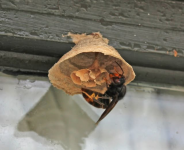
These hornets have a primary nest which is the one normally found on buildings and a secondary nest which is the one way up a tree. They do not apparently always move to a secondary nest but doing so is normal behaviour for them. They will be a lot easier to find before they move.
with this continuing, thats starting to sound like a good idea.It's not official policy but my advice to anyone in the outbreak area would be to put out poison baits over the whole summer.
get everyone to move their hives out of the area, then nuke it with poison baits. yes, sadly, there will be a ton of bykill. but if the aera is small its recoverable. possible now, won't be an option in 12 months time.
I was more thinking of just using vespex which generally only kills wasps anyway. My biggest worry is that hibernating Queen hornets were moved out of the area in things like firewood and even one undetected nest will lead to the same problem again.

MPI under pressure to step up war on Asian hornets as petition gains traction
Petitioner Brad Windust has demanded MPI take five additional actions
Nope, personal aquaintance... I've seen a photo, it looks just like an early common wasp nest......yet the owner said MPI said oh yes that a hornet and took them away...Do you have a link to the article?
Last edited: