Koss Russian bee setup

Welcome to NZ Beekeepers+
Would you like to join the rest of our members? Feel free to sign up today.
Sign up
147
99
Russia
Experience
International
Yes, we have that trait here in NZ also, just, not enough. It's only fairly recently it has become talked about as opposed to normal VSH where the larva is destroyed.
Imagine if you didn't have to treat bees for mites like in the good old days? Or reduce the amount of treatment to once a year?
I think you would reduce your costs of buying medicines that cost as much as a Boeing wing and there would be savings in labor costs, and your free time could be spent on more enjoyable activities when the bees do this work for you.
Treatment with chemicals leads over time to tick resistance to them. And in the long term this is a road to a dead end...
 
147
99
Russia
Experience
International
I will continue the topic about sacbrood. Subtotals.
A colony that I did not treat at all. She recovered on her own. I did not find any dead larvae.
I was never able to cure one colony. Even after press and isolating the queen. The dead larva still appeared in the brood. I have made the decision to replace the queen in this hive.
The other colonys, where the queens were isolated, feel well and show no signs of illness.
And now interesting conclusions.
Most likely there was only one sick sacbrood colony, and which I could not cure.
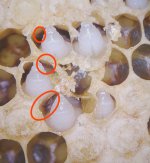
The remaining colonies simply showed the sign of recapping. I have one line that opens the brood at the larval stage rather than the pupa stage as usual.
That is, bees sense a mite in the brood, even when it has not yet begun to reproduce. Zero tolerance to ticks.
But there is a problem that some larvae die when open. This is not critical for the bee pupa. The humidity in the hive may have an effect. Don't know.
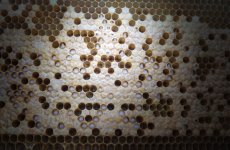
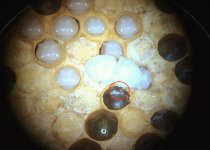
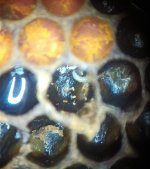
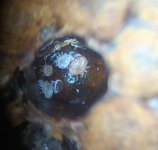
The photo shows a frame with the brood of one colony. Don't be alarmed. This colony was specifically infected with a tick. And in some cells there was a wax moth worm, so they are also open. The colony shows a response to infection. When she copes with the mite, the brood will be as usual.
IMG_20240703_133449_125101.jpg
IMG_20240703_133827_125102.jpg
IMG_20240703_094724.jpg
 

Alastair

Founder Member
Platinum
8,896
10,076
Auckland
Experience
Semi Commercial
I notice most of the re-caps seem to be in clusters or lines, do you think much of it was due to varroa mites?
 
147
99
Russia
Experience
International
I notice most of the re-caps seem to be in clusters or lines, do you think much of it was due to varroa mites?
When the dissected brood appears in the shape of a line, it is more likely to be a reaction to a wax moth caterpillar. A definite answer can only be given by examination under a microscope. In general, an interesting question is by what criteria does a tick choose one cell and not another.
FB_IMG_1720174356337.jpg
 
147
99
Russia
Experience
International
Hi all!
I have not written on the forum for a long time. I want to share good news.

A group of colonies that live without treatment since November 2023 passed a winter hardiness test. Of the 30 colonies, only 2 died.
In another group of colonies, which does not have resistance to the tick and is used to grow it (tick) in colonies. Of the 10 colonies, 2 colonies died.
The season was not easy, for almost three months there was a very strong heat - the temperature reached +40 С.
And winter brought its surprises. January was very warm and the bees carried pollen, and there was a brood in the colonies.
In February, the weather changed, and there were negative temperatures for a month. Reached -15 С.
February made me be very nervous.
I am very glad that the colonies survived and this season the work on the stability of the bees to the tick will continue this season
 
  • Like
Reactions: Gerrit and tristan
147
99
Russia
Experience
International
Nice work Konstantin (y)
Thank you, Alaster!
Last season gave a lot of information to think. It was amazing for me to observe as colonies that are susceptible to the tick have a very low degree of infection, being among the VSH colonies. Apparently, the hives and migration of bees close to each other play a very large role. The colonies with VSH are indirectly, but reduce the tick -borne load in neighbors.
The tick does not multiply exponentially.
 

Alastair

Founder Member
Platinum
8,896
10,076
Auckland
Experience
Semi Commercial
Очень интересно, Константин. Хотелось бы, чтобы у нас в стране были ваши пчелы, но, конечно, нам не разрешают. В каком городе вы живете? Моя подруга, которая из России, сейчас в России, возможно, вы рядом?
 
147
99
Russia
Experience
International
Очень интересно, Константин. Хотелось бы, чтобы у нас в стране были ваши пчелы, но, конечно, нам не разрешают. В каком городе вы живете? Моя подруга, которая из России, сейчас в России, возможно, вы рядом?
Yes, you have a very serious biological protection. It is probably easier for me to come to work to you😁. So if there is a team of like -minded people, ready to work in a VSH project, I am ready to consider options.

You have a very beautiful nature and very good conditions for beekeeping.
Our seasons do not intersect. It would be a very interesting experience and I have something to learn from you. I've always admired how many colonies your commercial beekeepers work with.
 
147
99
Russia
Experience
International
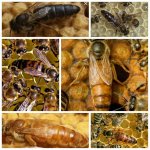
PhotoCollage_1745394089975.jpg
Hi all.
I would like to discuss one very interesting topic.
Does the color of the queen of bees affect the characteristics of the colony?
Probably all over the world there are no disputes that the red Queens are the best, only beekeepers say. Others object and say that there is nothing better than the black queens ... Who is right?
In my opinion, there is no evidence of color binding to any characteristics of the colony.
In any color, there are colonies that are strong, medium, and weak, aggressive and kind and color does not affect this.
Imagine if you hired people only with green eyes and claimed that these were the best workers ...
What do you think on this issue?
 
147
99
Russia
Experience
International
IMG_20250502_155455_074409.jpg
Raising high -quality drones is a complex process. More complicated than raising high -quality queen of bees.
Drone is a very tender creature, the amount of seed that it stores in itself depends on that you treated the colony with chemical drugs, how many Varroa in the hive, the hit of direct sunlight, the temperature, how well the bees take care of the drones, etc.
On average, one tarnish carries 1 μl of sperm. This is about 7-11 million sperm. (From my practice, I can say that with Single Drone Insemination, the queen can work on a full -fledged nest 1 season. Such insemination is done to work on the VSH project) Trucks also have a ripening period, and its fertility has a rather limited time. Under adverse conditions, the amount of sperm is greatly reduced, or there are drones in general "empty"
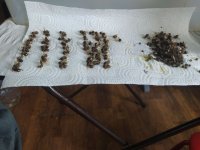
The photograph shows the process of collecting a drift seed. After each tenth of a drone, a special diluent is added. Therefore, they lie in rows, so as not to make a mistake with the score.
 
  • Like
Reactions: Alastair

Alastair

Founder Member
Platinum
8,896
10,076
Auckland
Experience
Semi Commercial
Very interesting!

You are getting better results per drone than I do. However I have not been very scientific about how I raise them.

I do agree with you that raising virgin queens is much easier than a properly run drone raising program.
 
147
99
Russia
Experience
International
Cropped_Image1747482449854_144823.jpeg
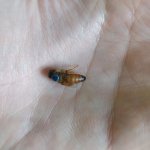
Continuing the theme of the color of the queens. In the photograph of the queen of bees of the Far Eastern population (type of Primorsky) with the stream of blood of the Bakfast in the second generation.
That is, the virgin queen arrived at me (her color was very dark), I inseminated her with a drone of the buckfast, rearing from her daughters and was inseminated once again with a buckfast. And from these daughters, such offspring are obtained.
There is no hint that once they had dark queens in the pedigree.
Depending on what color the drone will be, what color will be further offspring.
But this is not the most important thing. Success in breeding depends on the right paternal line. Initially, the Primorsky bee is quite aggressive, and when pouring bakfast, the bee changes very much for the better. In the second generation, you can already safely work without smoker.
 
  • Good Info
Reactions: Alastair

Alastair

Founder Member
Platinum
8,896
10,076
Auckland
Experience
Semi Commercial
View attachment 1850
Hi all.
I would like to discuss one very interesting topic.
Does the color of the queen of bees affect the characteristics of the colony?
Probably all over the world there are no disputes that the red Queens are the best, only beekeepers say. Others object and say that there is nothing better than the black queens ... Who is right?
In my opinion, there is no evidence of color binding to any characteristics of the colony.
In any color, there are colonies that are strong, medium, and weak, aggressive and kind and color does not affect this.
Imagine if you hired people only with green eyes and claimed that these were the best workers ...
What do you think on this issue?

In my view, the colour of the queen may be important, depending what you want.

So for example, Carniolan bees (if pure) winter in smaller clusters than Italian bees, and use a lot less honey. And these race related traits can be identified by colour. Likewise, Carniolans will swarm more than Italians, and this applies even to the hybrids between the two.

So yes, colour can matter, depending on what you want.

Of course in todays world where nearly all bees are hybridized to a greater or lesser degree, much of the understanding of this has been lost on a lot of beekeepers because almost no bees are purebred, so the colour is less related to certain traits. To many beekeepers, they are all bees, they make honey, and that's about all that matters.


Top